TOA
PAYOH VETS
toapayohvets.com
Date:
25 September, 2011
Focus: Small
animals - dogs, cats, hamsters, guinea pigs, turtles & rabbits
UMBILICAL
HERNIA REPAIR IN A SHIH TZU PUPPY - A stitch in time saves nine Case written: Aug 9, 2003
Case updated: Sep 25, 2011
Dr Sing Kong Yuen, BVMS (Glasgow), MRCVS
"What
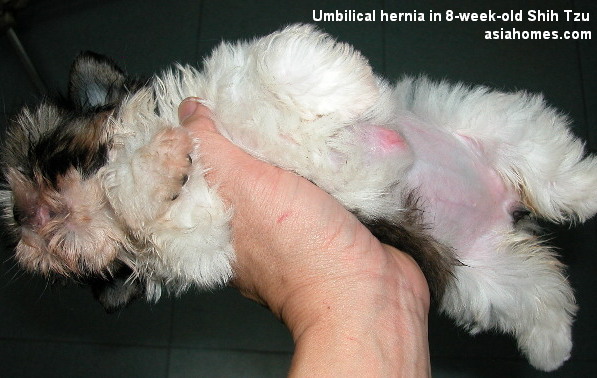
should I do with this 8-weekShih Tzu puppy with pink intestines about to
burst out of his belly button?" I asked myself. "Should I just mind my own
business and vaccinate the puppies as requested by Mr Formicelli and walk
away?"
This stunted puppy would die in the next few days as the large intestinal
loops get twisted further. The twists and turns of the loops would strangulate
the blood vessels. The intestines would be cut off from their blood supply
and becomes gangrenous. The puppy would die in a very
painful way.
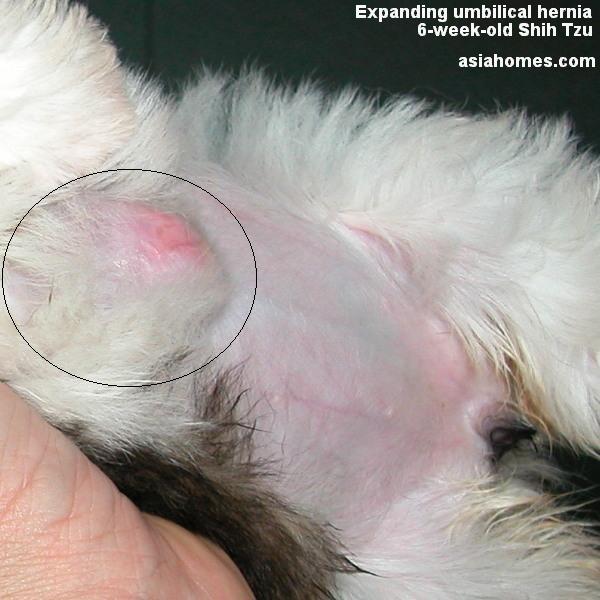
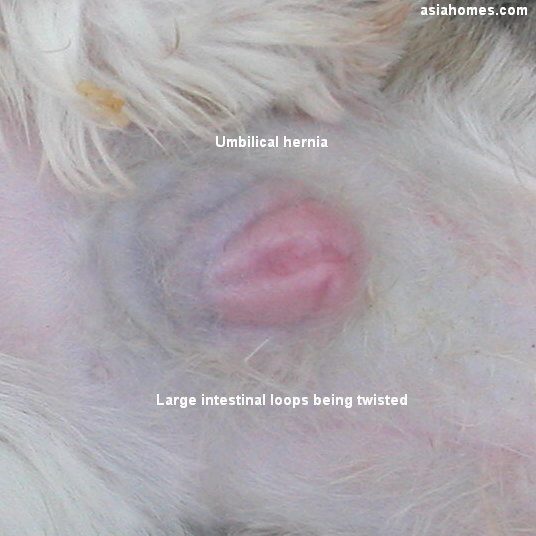
The diagnosis was a massive
umbilical hernia. The treatment was surgery to
close up the hole in the belly. However, this Shih Tzu puppy was in a poor bodily condition
with all her puppy fat lost. Was it now too risky to operate on her?
Veterinary anaesthesia books mention that puppies less than 12 weeks of
age are high risks, meaning they have a high rate of death from
anaesthesia. The Shih Tzu was 8 weeks old.
The puppy had licked the hernia a lot thinning the umbilical skin area. The weight of the abdominal organs and the friction
on the cage floor thinned the skin considerably to less than 3 mm thick now. I
could see the large intestinal loops under the skin. Any time, the skin
would rupture and the Shih Tzu, now skin and bones would die painfully as
the guts spilled out of her abdomen.
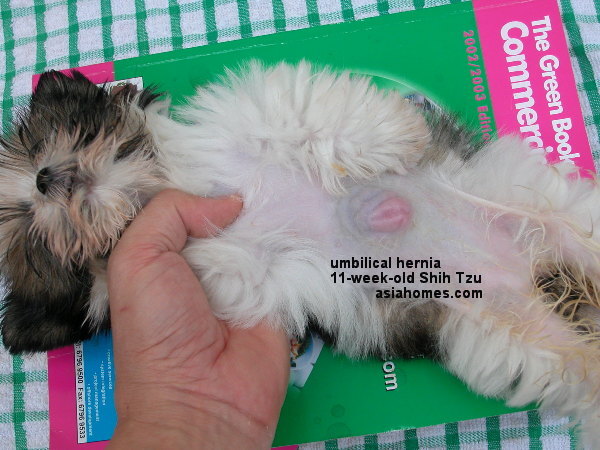
She
was smallest of the four Shih Tzu puppies when I vaccinated her at 8
weeks. She had a large umbilical hernia of
8 cm in diameter, a size bigger than the width of two adult fingers but
was otherwise eating and appeared healthy.
The breeder's assistant was very good at puppy care. He had seen numerous umbilical
hernias in puppies and would have informed Mr Formicelli of this unusually
large defect. He would have encountered puppies with small umbilical
hernias of various sizes.
I said to Mr Formicelli's assistant during vaccination, "This
8-week-old Shih Tzu needs surgery to repair the big gap in the muscle
layer of the belly region. Do ask Mr Formicelli for permission. It will be
hard to sell this puppy with such a large defect in her muscles."
The assistant did not get back to me. I phoned him a week later and he
said that Mr Formicelli had not decided on the surgery. "Was it the $200
cost of general anaesthesia and surgery?" I asked him but he did not say
anything. Silence is golden.
Many dog breeders and pet shop owners had to cut operating costs in this
severe economic downturn attributed to SARS (severe acute respiratory
syndrome) and I could understand that. But $200 should not be a big
problem with Mr Formicelli who was a very successful operator, I thought.
Yet, every dollar saved is a dollar earned. After all, Singapore Airlines,
reputedly the world's most successful airline over the past twenty
years, was cutting salaries of pilots and retrenching staff during this
period.
In retrospect, I should have phoned Mr Formicelli to warn him
about the impending death of this Shih Tzu with such a large hernia. But that would be tantamount to touting. Mr Formicelli might feel offended although he would be too polite to tell me
off.
Most important of all, there was no guarantee that an 8-week-old puppy
would survive the general anaesthesia and post-operation days too.
He still would have to pay for the surgery.
3 weeks passed.
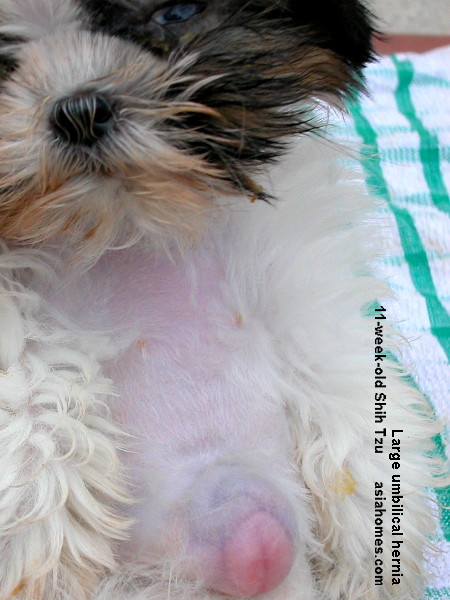
Now I could not believe my eyes. The 11-week-old Shih Tzu's inflamed
hernia skin
was stretched a lot, weighed down by the internal organs. Just like
pregnant women with stretch marks, but this was much worse. The herniated
area was very thin now, due to continual licking by the puppy to relieve
the pain and discomfort. The skin became inflamed. I could even see that a
loop of the large intestine is inflamed, due to the friction between it
and the floor.
Her large intestinal loops imprinted onto the skin a U-shaped
stamp. A triangular lump above the U-shape could be the lobe of a liver.
In a few days, the skin would rupture as it became thinner than paper. The
intestines and liver lobes fall out of the body. A very painful death,
just like being stabbed in the abdomen.
Somehow, it did not feel to abandon this Shih Tzu which was more lively
and grown up than three weeks ago. Was there a way to help this Shih Tzu? What
could I do? Why should I be bothered?
This hernia could be repaired but would the puppy survive the general
anaesthesia and post-operation surgery? Would I provide free services if
the puppy died on the operating table.
The chances were slim. Most veterinary surgeons would not like to
anaesthesize puppies less than three months old. They are high anaesthetic
risks. The surgeon gets a bad reputation - "the puppy died when the vet
operated on it" would be spread by word of mouth and via the internet.
It was so easy to walk out of this Shih Tzu puppy and mind my business
after completing my vaccination of the breeder's puppies. Mr Formicelli was not
at the shop.
There
was one foolhardy option.
"Will you sell the puppy to me for $50?" I asked Mr Formicelli's mother. A
silver-haired slim woman in her seventies, she was grooming a poodle. She
did not need to work at all and could enjoy her mahjong sessions and
shopping in Singapore, a city known to have more shopping malls than New
York.
She could afford the fanciful coiffured hair style, wavy and permed like
other Singapore's tais tais (ladies with wealth), but she did not need
these displays of wealth. She cut her
hair short and tied two rubber bands onto two pony tails.
"$200," she replied in a somber tone. Her sun-tanned face revealed no
emotion. "Nobody would purchase this defective puppy," I thought but
did not say. Therefore,
it had zero value. Why pay anything? As my offer was rejected, it should
be wise of me back out. If she had said yes, I
could not demur.
"This puppy needs an operation," I murmured.
"$100," she said without looking up as she clipped the puffed
up head hair of the white toy poodle for its Kennel Club dog
competition. Now, I know why Mr Formicelli is so successful in his
canine pet shop business. He had good training from his mum. If she could sell
this puppy for $100, she could sell ice to Eskimos.
"The operation to repair the hernia will cost more than $100," I replied.
I had blown away a second chance to back out. I had not done a veterinary
examination of the Shih Tzu puppy. I had not even checked whether she had
a normal heart if I was to perform surgery to repair the hernia. It was rash to offer to
buy a such a puppy.
"$50" Mr Formicelli's mother said. Better to get $50 than pay more
for an operation for a sickly puppy. She knew about the fragility of
runts, of stunted puppies in her four decades of pig farming which was
extinguished by the Singapore Government's policy in the 1980s.
This
puppy would not survive for the next few days if she was not operated as
the skin in her umbilicus had thinned due to licking. Soon the skin would
rupture and the guts would flow out from the big hole. Death was staring
us in the face.
Since my offer of $50.00 was rejected earlier, I could back out of her new
offer which was $50.00.
However,
I paid and took the puppy back to the surgery and put her in a cage for observation
for one day. She did bark a few times for attention at the Surgery. What a strong girl!
But she was nibbling a bit of dry dog food just to survive. Like an
anorexia nervosa teenaged girl who is afraid of being fat.
I had better operate on day two as the intestinal loops turned fiery red
under the skin. The intestinal loops could be twisting and the blood
vessels would be partially strangulated.
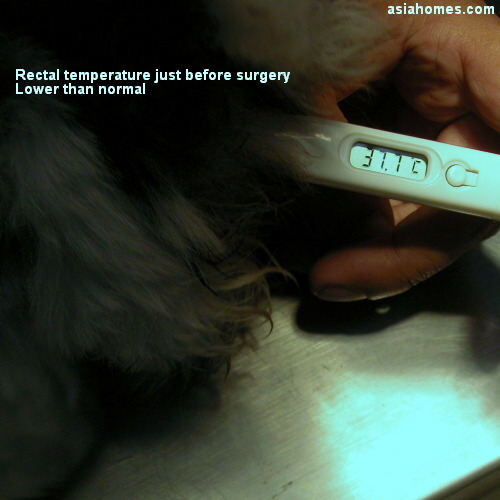
Her rectal temperature was 37.7 degrees Celsius pre-operation. Normal
temperatures are around 38.5 - 39.0 degrees for a puppy. She was
going into hypothermia. I gave her a dextrose drip prior to anaesthesia to
increase her chances of survival.
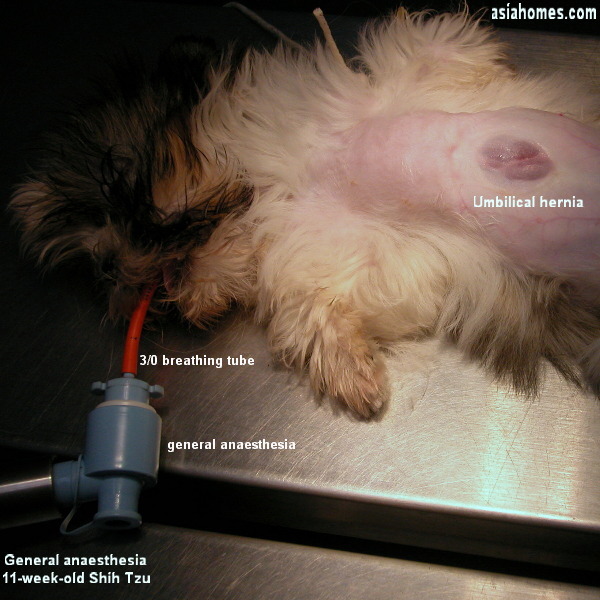
I covered the puppy with a face mask to give her the gas anaesthesia.
She struggled weakly to avoid
breathing the gas. Would her heart fail to beat in the struggle?
When she was just in deep anaesthesia stage 10 minutes later, I pulled her
tongue and inserted a 3/0 endotracheal tube (breathing tube) inserted
into the windpipe.
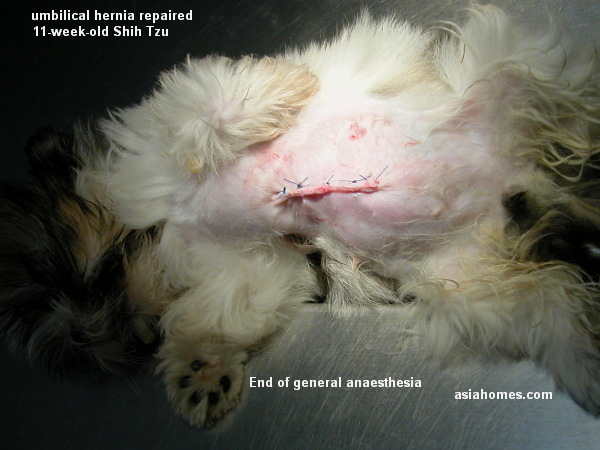
I incised the thin skin. A big operation wound from her navel to her
sternum. The hernia was massive unlike other dogs as the linea alba
connecting the left and right halves of the muscles was split. I exposed a big 8-cm hole
after undermining the skin. The light brown liver lobes and
intestines glistened under the operating light. .
Where were the left and right abdominal muscle layers needed to stitch up
to cover this gap? The paper-thin skin was just holding the internal
organs.
Nurse Ann furrowed her forehead: "The puppy is moving her front legs." The
light brown liver lobes and the large intestinal loops started to spill out of the
incision.
"Increase the anaesthetic by 0.5%" I said to Nurse Ann. Would the puppy
die? What would be the safest dose of gas? There was no fixed percentage
for high- risk puppies but normal adult dogs could be maintained on 2.0 -
2.5% of the gaseous anaesthetic. I had to be observant.
I needed to operate fast. But where were the two left and right abdominal
muscle layers to stitch and close up the wound? In small hernias, I could
see the muscles as the gap was small.
This was a 8 cm diameter hole protected by the skin only. Were there any
muscles in the first place? I loosened the skin layer by undermining
the skin with my scissors.
I lifted the
skin up with the forceps. The muscles had retracted far away, nearer to
the top of the rib cage. I snipped off the excess skin stretched paper-thin by the herniated intestines.
I pulled the left and right layers of the skin and stitched them.
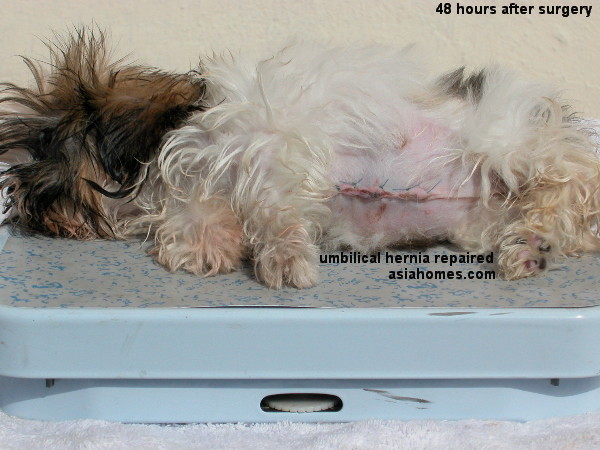
The puppy was kept warm in a cage after the end of the operation. 12 hours
later, she could not sit up. Fainted. She was hypothermic
again and laid down on her side. Would she survive? She was forced fed an
egg.
24 hours later, she could eat on her own. She sat on her sternum like all
puppies. But she was not eating much. I checked her gums. They were pale
pink. The tongue was also pale pink. She coughed occasionally. A dry
hacking cough, just like the kennel cough common in puppies kept at pet
shops. No fever.
She screamed when I injected antibiotics and dextrose saline under her
skin to rehydrate her and given her nutrients. Would she survive the kennel cough infection? I force fed her
another egg and went to see Mr Formicelli's mother.
She must have
thought that I wanted to return the puppy and wanting my money back. Like
so many buyers who became unhappy after purchasing unhealthy puppies from
pet shops.
"What brand of puppy food did you feed the Shih Tzu?" I asked as I showed
her a sample of what I fed to the puppy. The puppy was not eating much and
it might be because I fed her another brand of dry feed.
"That's brand A," she said instantly as she recognised the greenish brown
triangular pellets.
"I feed the Shih Tzu brand B." She presented me a small plastic container
of small
globular chocolate brown pellets. She stopped her sales girl who was
selling me a full bag. Then she sealed a small plastic bag of oats
for this Shih Tzu. I thanked her. The puppy was used to the breeder's
formula and it would be wise to give the same feed.
36 hours later, the Shih Tzu had better appetite and passed a larger
amount of greenish stools. She barked strongly and her tongue was a better
colour of pink. That was a good indicator of good health. This was a real
hardy Shih Tzu. If she could live for the next seven days, the shadows of
death would be banished by the light of life.
Why did Mr Formicelli not operate this puppy earlier? A stitch in time
saves nine. I just had to know. I mobile phoned him. "The puppy had fever
the past week and was treated," Mr Formicelli explained. "I would send her
for surgery when she had fully recovered in two weeks' time."
I
told him that her mum had sold the puppy to me. Breeders lose their
respect for vets who tout for their business patronage. Respect does not
pay the bills though as the cost of doing business keeps going up in
Singapore as the bureaucrats think of ways to charge fees for new
and various licensing regulations to justify their bonuses and existence. Sometimes
it is better for a veterinarian to be flexible in dealing with large
breeders rather than ask for respect. Touting may not gain respect but it
puts bread on the table.
There are many canine problems in the pet shop and breeding farms to
treat, but the cost-conscious operators would rather self-treat. If
they could operate on hernias, they would do them.
In this Shih Tzu, an early operation at four weeks of age would be best.
If she survived the anaesthesia, she would have put on weight and be
valued at $800 for sale at 3 months of age. The anaesthetic time
would be much shorter. "A stitch in time saves
nine" seems appropriate for this case, thanks to my English teacher who
used to force the students of my generation to memorise such phases in the
primary school in the 1960s.
There was a possibility of Mr Formicelli spending more than $200 and losing a puppy
during or after anaesthesia. If the puppy was not operated and died, it
would just be one of those losses in the dog breeding business. It
was pragmatic of him not to throw good money after bad as there was no
guarantee that the puppy would not die on the operating table.
The puppy was weak during the 3 days after surgery. Her tongue was pale.
She was hand fed and given antibiotics and fluid therapy. In the second
week after surgery, she put on weight. Her incisor teeth had not erupted
yet as Shih Tzus take a longer time. She was a very small sized puppy now.
It took another 2 months of nursing before this Shih Tzu put on weight as
normal puppies do. Eat, sleep and play. Small circular patches of
hair loss appeared under her armpits and in her groin.
It was a ringworm infection.
Nurse Ann shampooed her with the anti-fungal
wash. More red circles appeared on her elbow and body. The washing could
spread more fungal spores. I gave her anti-ringworm medication
for twenty days as well as the shampoo. She recovered after 3 weeks of
treatment.
Nurse Ann put the advertisement of "puppy for sale" in the internet.
She wanted to sell the puppy because giving her away to Singaporean
friends was not good for the puppy. When puppies are presented to friends,
they are not well looked after as compared to paying a price for it. Some
friends return the puppy later when they get fed up of the puppy or when
the puppy is sick. This is a type of Singaporean culture that still exists in
2008. It is quite distressful to the original owners of the puppy when
friends abandon and return a living gift.
Nurse Ann sold the puppy for $100 to a young couple who was informed that
she had an umbilical hernia repair.
With education during my extension visits in the 2003 -2005 period,
professional dog breeders were asked not to breed from affected parental
stock as umbilical hernias are hereditary. What happened was that
beautiful Shih Tzu pups or those with the beautiful colours were bred,
resulting in several cases of umbilical hernias in Shih Tzus seen in the 3
professional dog breeders who wanted me to vaccinate their puppies. For
the breeders, selling a puppy with umbilical hernia is not a good business
proposition as the buyer may return the puppy and want the money back
after a veterinary purchase examination.
UPDATE IN 2008. Seldom will Singaporeans find a Shih Tzu puppy with
hernia for sale at the pet shop or the breeders. The breeders had
been educated and they eliminate breeding from affected parental stock.
UPDATE IN 2011. Umbilical hernias in Shih Tzu puppies are
relatively rare in Singapore nowadays as the
professional dog breeders get wiser and stop breeding from
affected ones.
See a case report of the
Inguinal hernia in a Shih Tzu puppy in Hawaii.
UMBILICAL HERNIA REPAIR SURGERY.
Umbilical hernia repairs can be done in 6-8-week-old puppies under
general anaesthesia gas. No food for 6 hours prior to
surgery. No tranquilisation. Straight into gas mask.
Intubate the puppy. The maintenance dose is around 0.5-1%.
Be observant and give the minimal dose. Prepare pre-op.
Surgery must be quick to minimise risks of death.
 TOA
PAYOH VETS
TOA
PAYOH VETS